Rainwater Leakage Inspection
Inspect visible water stains, damp patches and entry points around exterior walls, window frames, ventilators, balconies, roof edges and building joints that may allow rainwater to enter.

Home Inspection 360 provides water leakage inspection for houses, independent homes, apartments, villas, offices, hospitals, factories, shops, commercial buildings and other properties in Chennai. We investigate visible signs of water entry or seepage affecting walls, ceilings, roofs, terraces, floors, plumbing areas and building surfaces.
Possible sources include rainwater entry, concealed or exposed pipe leaks, bathroom and kitchen plumbing, water tanks, drainage connections, terrace waterproofing defects, roof joints, window edges, cracks and water-use areas. Our inspection combines visual assessment with thermal imaging and moisture-meter checks where suitable and available.
Visual inspection · Moisture checks · Thermal imaging where suitable · Photo documentation · Recommendations for next steps
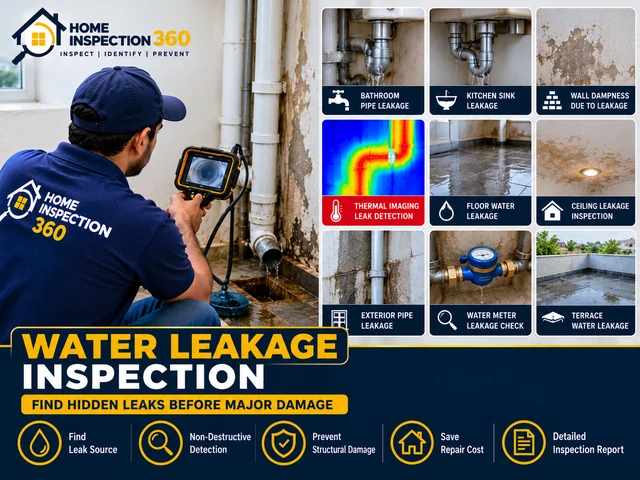
Water may travel through a slab, wall, pipe chase, tile bed or building joint before becoming visible at another location. A ceiling stain may be associated with a bathroom or pipe above it, while a damp wall may relate to rainwater entry, plumbing, a terrace junction or another moisture source. We inspect visible symptoms and relevant accessible areas to help narrow down possible causes.
We assess the reported problem, affected surfaces and accessible nearby areas. Findings distinguish directly observed conditions from suspected causes. A non-destructive inspection cannot confirm every concealed leak, and specialist tests may be needed depending on the site conditions.
Water leakage inspection investigates pipe leaks, roof and terrace seepage, damp walls, ceiling leakage and bathroom or kitchen water ingress using visual checks and suitable diagnostic tools such as a thermal camera and moisture meter. It aims to identify likely sources and next steps. Repair work is separate, and a non-invasive inspection cannot guarantee that every hidden leak will be found.
Our water leakage inspection checklist covers common sources and symptoms across residential, commercial and institutional buildings. The exact inspection scope depends on access, safety, permissions and the service agreed before the visit.
Inspect visible water stains, damp patches and entry points around exterior walls, window frames, ventilators, balconies, roof edges and building joints that may allow rainwater to enter.
Check accessible roof and terrace surfaces, parapet junctions, cracks, outlets, drain points, tile joints and visible waterproofing wear for signs associated with rainwater seepage.
Assess dampness patterns and accessible plumbing points that may indicate a concealed supply-pipe leak. Exact pipe tracing or confirmation may require pressure testing or specialist equipment.
Visually inspect accessible pipes, elbows, valves, couplings, flexible hoses and joints for dripping, corrosion, wet surfaces and visible water escape.
Document peeling paint, bubbling, damp patches, salt deposits, staining, cracks and moisture symptoms on internal or external walls. The visible mark may not be at the original source.
Check accessible ceiling surfaces and slab areas for water marks, dripping, plaster damage, cracks, dampness or rust-coloured stains that may be associated with leakage from above or nearby services.
Inspect accessible tile joints, grout, sanitary fittings, WC connections, shower areas, floor traps and wall-floor junctions for visible defects and water-seepage symptoms.
Check accessible sink waste pipes, taps, bottle traps, under-sink cabinets, washing-machine connections and nearby walls or floors for dripping, swelling and moisture damage.
Inspect accessible tank surroundings, visible inlet and outlet connections, overflow pipes, nearby walls and slab surfaces for signs of water escape. Tank integrity testing may require a separate procedure.
Check accessible drain covers, visible waste connections, floor traps and surrounding finishes for gaps, staining, persistent wetness or signs that may need additional drainage testing.
Examine accessible frame edges, sill junctions, sealant, glass beading and façade joints for visible gaps or deterioration that may permit rainwater entry during wind-driven rain.
Record visible cracks and open joints on walls, parapets, slabs and external finishes where moisture is present. Crack appearance alone does not establish the water source or structural significance.
Inspect accessible balcony floors, wall-floor junctions, drain points, thresholds and adjacent ceiling or wall surfaces for water marks and possible seepage paths.
Check accessible AC drain outlets, condensate lines, nearby wall openings and ceiling areas for dripping or dampness that may relate to blocked, disconnected or poorly routed drainage.
Where suitable and available, use thermal imaging and moisture readings to compare affected and nearby surfaces. Results are supporting indicators, not standalone proof of a leak or its exact source.
Inspect accessible laundry rooms, wash areas, plant rooms, service areas and other locations with water supply or drainage for visible leaks and related moisture symptoms.
Check accessible exterior finishes, wall junctions, ledges, parapets and service penetrations for water staining, open gaps and deterioration that may contribute to water entry.
Where access and permission are available, compare affected ceilings or walls with relevant wet areas, plumbing routes or rooms above to investigate possible cross-floor seepage.
Record visible mould-like staining, musty odours, peeling paint, damaged plaster, swollen finishes and corrosion stains. Laboratory identification and remediation are separate services.
Document visible dampness, cracks, rust stains or concrete deterioration on accessible beams and columns. Suspected structural damage or exposed reinforcement should be assessed by a qualified structural engineer.
Inspect only where access is authorised and safe. Look for visible water marks, wet pipe connections and seepage around service penetrations; opening sealed shafts is not included unless separately agreed.
Record wet floor edges, damp skirting, lifted finishes and low-level wall staining. These symptoms can have several causes and may need further checks to distinguish plumbing leaks from other moisture sources.
Inspect agreed accessible areas in offices, hospitals, factories, shops and commercial buildings, including ceilings, utility zones, washrooms and visible service connections, subject to site safety and permissions.
Review the reported timing, weather conditions, water-use patterns and earlier repair history, then document whether visible symptoms remain or further testing should be considered.
Water can travel through building materials and appear away from its entry point. We consider the location and timing of the symptoms, recent rainfall, water-use patterns, plumbing routes and accessible areas above, beside or below the affected surface. These clues help guide inspection but do not by themselves prove the cause.
Thermal imaging displays surface-temperature differences that can help identify areas for closer investigation. Patterns can also be influenced by sunlight, ventilation, materials and other conditions, so they must be interpreted alongside other evidence.
Moisture readings help compare selected surfaces. Results depend on the material and instrument and do not independently locate a concealed leak or prove the source of water.
Visual inspection documents accessible symptoms, visible pipework, joints, cracks, stains and damaged finishes. Some cases require plumbing pressure tests, controlled water tests, drain testing, specialist leak tracing or opening-up work.
Depending on the agreed service, the report may include property details, areas accessed, photographs, observed defects, moisture observations, thermal-image observations where obtained, limitations and recommended next steps.
Destructive testing, wall or tile removal, concealed pipe tracing, plumbing pressure testing, tank integrity testing, drain-camera surveys, laboratory testing, repair work and certification of concealed waterproofing are not automatically included. These must be discussed separately.
Home Inspection 360 can provide an inspection summary based on the agreed scope. The report should separate directly observed conditions, instrument readings and possible causes that require further verification.
Photos of accessible affected areas with location-specific notes.
Relevant moisture readings and comparison notes where measurements are taken.
Thermal patterns recorded where imaging is used, with appropriate interpretation limits.
Potential contributing areas based on available evidence, without guaranteeing source identification.
Suggested plumbing, drainage, roof, waterproofing or specialist tests where required.
Areas not accessed, permissions needed and additional checks recommended.
We accept enquiries for water leak detection, rainwater ingress, pipe leakage, wall seepage, ceiling leakage, terrace and roof leakage, bathroom and kitchen leakage, water tank areas and building moisture concerns across Chennai, subject to availability and safe access.
Residential, institutional and commercial property enquiries are welcome. Contact us to confirm service coverage, charges, appointment availability and any access arrangements needed.
T. Nagar, West Mambalam, Nungambakkam, Egmore, Kilpauk, Chetpet, Kodambakkam, Vadapalani, Ashok Nagar and Saidapet.
Adyar, Besant Nagar, Thiruvanmiyur, Velachery, Madipakkam, Nanganallur, Medavakkam, Pallikaranai and Perungudi.
Porur, Valasaravakkam, Virugambakkam, Mogappair, Ambattur, Avadi, Poonamallee and Iyyappanthangal.
Thoraipakkam, Karapakkam, Sholinganallur, Navalur, Siruseri and nearby apartment communities.
Palavakkam, Kottivakkam, Neelankarai, Injambakkam, Akkarai and Uthandi.
Tambaram, Chromepet, Pallavaram, Selaiyur, Sembakkam, Perungalathur and Vandalur.
Enquiries from Kanchipuram, Tiruvallur and Chengalpattu are welcome, subject to availability and the exact property location.
We accept enquiries for rainwater entry, roof and terrace seepage, visible and suspected concealed pipe leaks, wall and ceiling leakage, bathroom and kitchen leaks, water tank areas, drainage symptoms and other accessible building moisture concerns.
Not in every case. Visual checks, moisture readings and thermal imaging can help narrow down areas for investigation, but exact confirmation may require pressure testing or specialist leak-tracing methods.
Yes. We inspect accessible affected areas and visible external openings, roof or terrace junctions, window edges and cracks where safe access is available. The actual entry point may need additional testing, particularly if the leak is intermittent.
Yes. Accessible fittings, visible joints, under-sink areas, wet-area surfaces and related wall or ceiling symptoms can be checked within the agreed scope.
Suitable tools may be used where appropriate and available. Thermal patterns and moisture readings are supporting evidence and do not independently prove the source of leakage.
Yes, where the relevant areas are accessible and permission is provided by the owner, resident or building management. Please arrange access before the appointment if cross-floor checking is needed.
Enquiries are welcome for residential, institutional and commercial properties. The inspection scope depends on site conditions, safety rules, permissions and the areas agreed in advance.
No. Inspection and repair are separate unless specifically agreed. The report may recommend follow-up checks or suitable specialist trades based on the observed conditions.
No. Concealed pipework, waterproofing layers and inaccessible spaces may need specialist or destructive testing. A non-invasive inspection cannot guarantee detection of every hidden leak.
Call or WhatsApp 9600696919 with your locality, property type, affected area, when the leak occurs and whether it relates to rain or water use. Appointment timing, access, scope and charges will be discussed and confirmed by phone before the visit.
Inspection findings describe conditions observed during the visit and within the agreed scope. Moisture readings and thermal patterns require suitable interpretation and may need independent verification. Concealed pipework, waterproofing membranes and inaccessible components cannot necessarily be assessed without additional testing or opening-up work.
This service is not a substitute for structural engineering assessment, plumbing certification, electrical certification, laboratory testing or statutory compliance checks. Suspected structural movement, severe concrete deterioration or exposed reinforcement should be referred to a qualified structural engineer.
Seeing water stains, rainwater seepage, pipe leakage, a wet ceiling, damp walls, terrace leakage or unexplained moisture? Contact Home Inspection 360 to discuss an inspection for your house, apartment, villa, office, hospital, factory or commercial building.
Please share your locality, property type, affected area, symptoms, whether the leak occurs during rainfall or water use, and any access requirements. Booking and appointment timing will be confirmed by phone.
Home Inspection 360 accepts enquiries for water leakage inspection across Chennai and nearby districts, subject to appointment availability, property access and the scope agreed before the visit. Localities we cover include:
Locality not listed? See the full service areas page, call or WhatsApp +91 9600696919, or book an inspection.